Joar Ledin
Passionate developer with a love for engaging games and stories!
Vell-versed in MOBAs, GSGs, TTRPGs, Co-Op Games and Roguelikes.
Experienced writer in Swedish, British-English and American-English.
Principle 01
Narrative design — Content design
Principle 02
Game design — Systems design
Game content is not always fun, interesting or engaging. Let me help you with that!
Solo Developer
ROGUELITE CO-OP HERO-BASED DUNGEON-CRAWL
Darkest Dungeon Revised (abbreviated to REV) is a mod for the game Warcraft III. REV supports up to eight players each playthrough as well as single-player. Combat is in real time: dangerous yet unavoidable. The narrative is a fantasy conjunction of good, evil and driven heroes coming together to thwart a major catastrophe. Macro skill is expressed through preparation and planning ahead. Players must fulfill their respective roles and support each other.
Victory is the goal, but it is almost certainly out of reach. Players will fail and repeat their mistakes, until their skills and teamwork come together, or they strike gold through luck. Yet, victory is never enough. REV offers countless ways to play and tackle the game, with enough variation and encounters to ensure that one can never truly master it all.
Project
History
REV is the successor to DD Reforged, which is an spin-off of the original Darkest Dungeon mod for Warcraft III created by the developer UselessLORD. The base game received an update which impacted existing mods in a significantly negative manner, including the original mod. To make matters worse, I played a way older version of the mod which newer versions branched away from. Eventually, I decided to return to digital game development and create an update to remedy the hundreds of errors. The stars aligned and it grew into a new project as well as a large part of my life.


Basic Loop
REV is played from a top-down perspective on a small map. Each player controls a hero, which is character object that gains experience points and learns abilities. These heroes also get to choose from optional talents, which manipulate the hero or its abilities in different manners. Each hero is mechanically and narratively different from each other, and can be further customised through hero skins which have cosmetic alterations; some skins also impact the hero’s gameplay in a light or significant manner, but these are generally weaker than the original hero.
The heroes form a cooperative group and venture through the procedurally generated levels, working together to stay alive. Should every hero die, the playthrough ends and the only way to play again is through hosting a new lobby. Victory is achieved through defeating the final enemy. The gameplay is roguelite, which means that the players’ meta-progression is saved but each hero starts from scratch with every new playthrough.
The players have three gameplay loops, the first being attached to the meta-level: restarting, playing, winning/losing.
The second one is the major goal: entering a new section, traveling through all rooms, reaching the section’s goal.
The final one is the most frequent one, it occurs through entering a new room, encountering the challenges, receving the consequences.
Live-Service
The six-year development of RF + REV was conducted through community-interactions, mainly via Discord-communities in stead of blog forums. Through these interactions the players suggested content, provided feedback on changes, reported bugs and filled out forms to help me gauge the current state of the game. Having taken on the role of community manager as well, it became my duty to accept the brunt and harsh responses that could come. REV, being a mod that border the line between fair and unfair, has been a great option for driven players! As these players grow experienced, so do their perception of balance. Content has to tread the fine line of balance, even that which benefits players negatively impact the experience. Players that do not use forums gladly share their thoughts in private or in-game, which has only broadened my view in a positive manner.
Significance of Design and Direction
Lodestar
REV’s lodestar has always been clear: a grim dungeon crawl filled with horrors, strife and fantastical powers. Reading it out does not distinguish it from similar work, and truthfully it does not have to re-invent these themes; these types of settings are popular for a reason. What I have always attempted to do is to pour extra effort into letting the gameplay follow the lodestar without losing the sense of variety. Gameplay and narrative can be interpreted as the same thing, and this is especially evident once a player recognises the patterns. One theme is tied to a specific gameplay effect, which creates expectations. For example, when one recognises either component it is expected for the component to follow the established pattern, which could be that the colour purple is used by cosmic horror-entities.
The difficulty comes when one attempts to either use the same colour or cosmic horrors for other parts of the game: suddenly there is the pattern is broken. I opted to design content which both respects and stretches these patterns at the same time, the downside being that the brainstorming for it is quite time-consuming and not always fruitful.
Genre
The actual gameplay genre of REV might at a first glance not appear unique, but that’s a misinterpretation. Multiplayer games with similar hero-based RTS-derivative gameplay are in almost all cases player-vs-player and/or free-to-play, which means that they fall into the MOBA-pool and fight for longevity. On the flip-side, there are a lot of dungeon crawlers, both singleplayer and co-op ones, but very few of these could gameplay-wise actually be seen as similar to REV.
The gameplay genre of REV is unintentionally deceptive, for example, the players each control a hero and the game takes place in an arena, which would make it a MOBA, and because the player controls a single character and nativage through narrative interactions as well as a leveling system as well, “that makes it a RPG!”. It contains these elements but does not belong to either of those genres. A lot of co-op games have a form of comraderie or fun-with-friends aspect, but they rarely capture the feeling of serious camaraderie. The common pratfall is designing a singleplayer mode and adding co-op secondary. I would probably name REV’s genre something engaging or explanatory, but the videogame industry has been quite adamant about not accepting new genres as of late.
The Hero’s Journey
Both the genre and lodestar topics explore a form of pattern and expectation, and I set some expectations with this header, right? Truthfully, I planned to name this one narrative (dis)expectations. Hearing the word hero in a game or story, one might interpret the narrative as a grand adventure that promotes power fantasies. I do not design to break this trope; I design to round it out.
The existence of a hero indicates that there have been, are, and will be more of them. If there are eight players and each control a hero, then there is likely even more heroes out there. These narrative assumptions tie into the gameplay, and if a hero no longer is intepreted as the “one and only” then it might be nothing more than a label, right? That is not my aim either. A player’s hero should have the tools and opportunities to feel special, unique and powerful, but it should not begin with narrative expectations that puts it above friends nor foe. REV, like my other projects, is designed to let heroes be heroes through the gameplay and interactive narrative, while at the same time saying: “heroes can be weak and challenges can prove insurmountable”.
Content
Replayability – Assignment
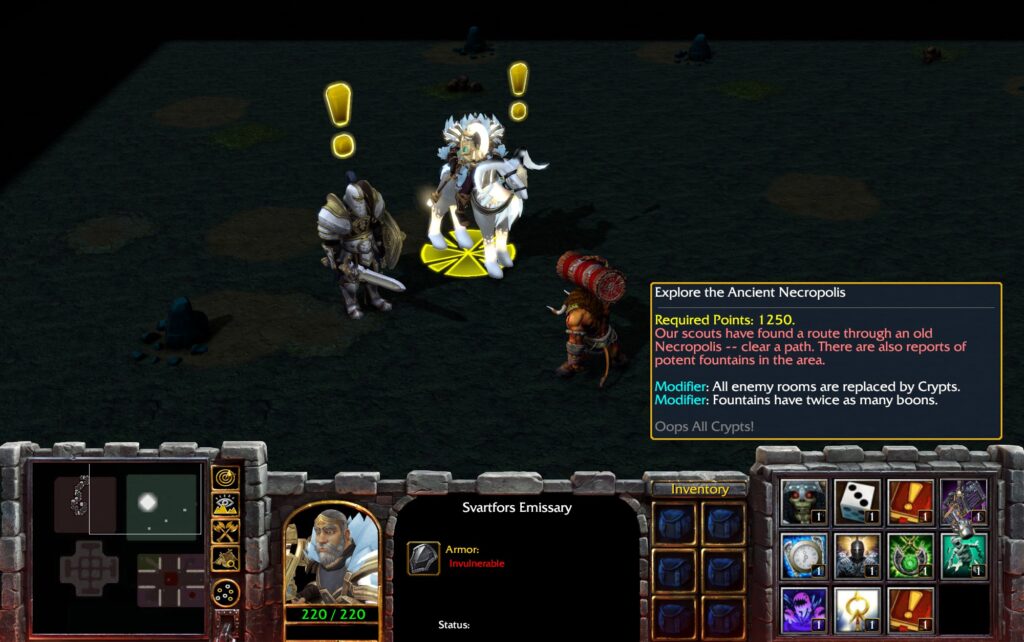
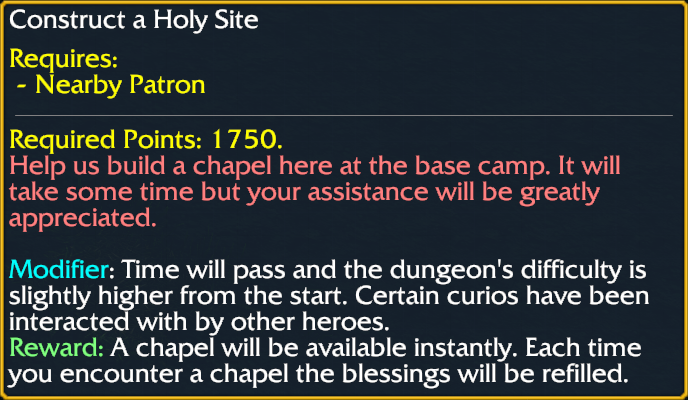
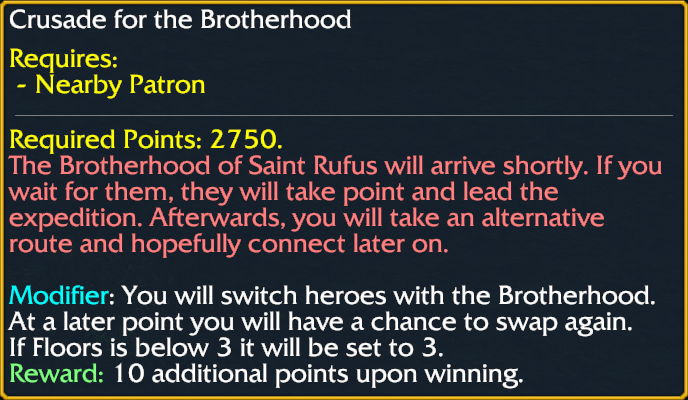
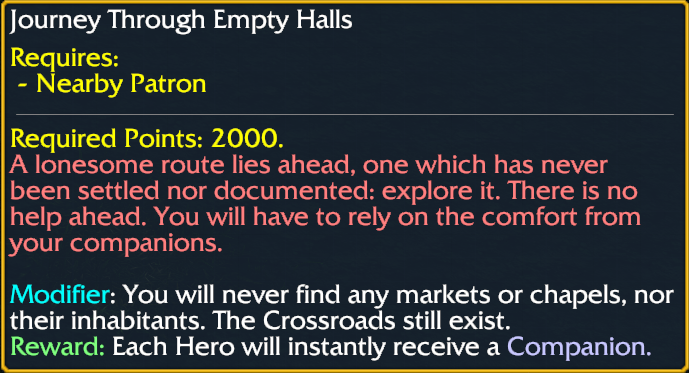
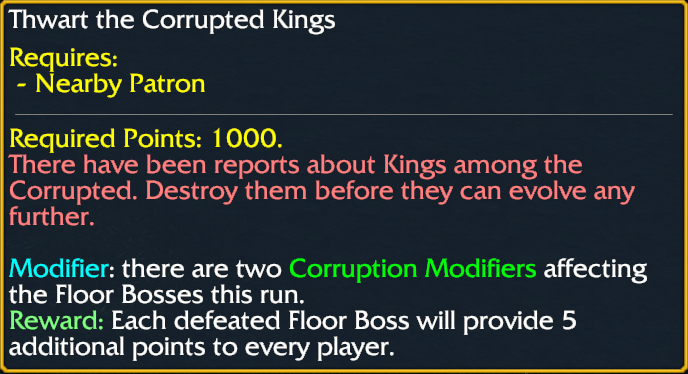
An assignment is an optional gameplay mechanic that significant modify the scenario. They are presented in the form of a classic quest despite. There are twelve different assignments to choose among, and they are unlocked through meta-progression since they generally increase the complexity or difficulty. Assignments were designed to impact different parts of the gameplay in significant manners, to make sure the player make a deliberate choice picking one.
The hardest assignments are in a sense the final challenge for completionists and masters of the game.
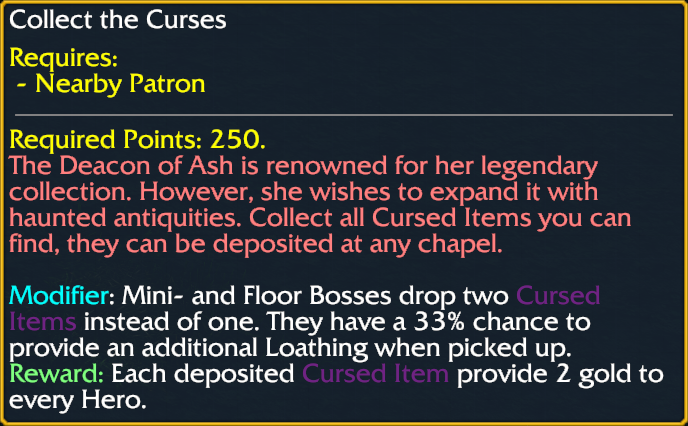
Replayability – Corruption
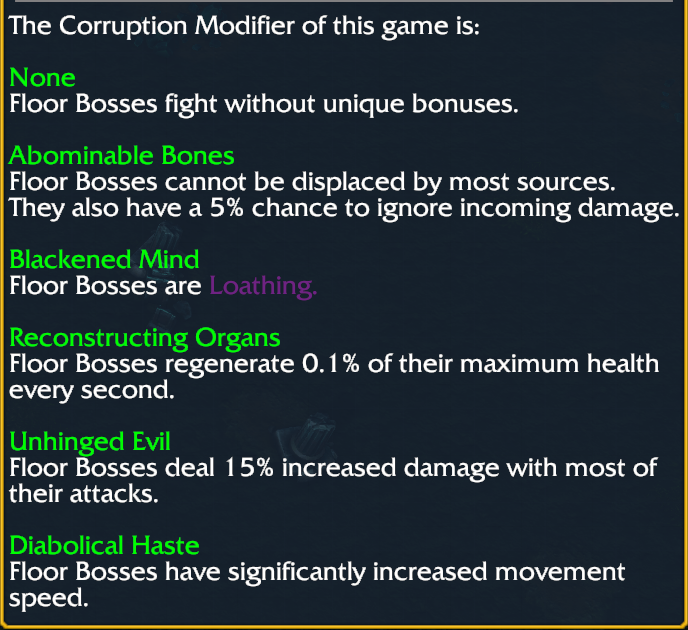
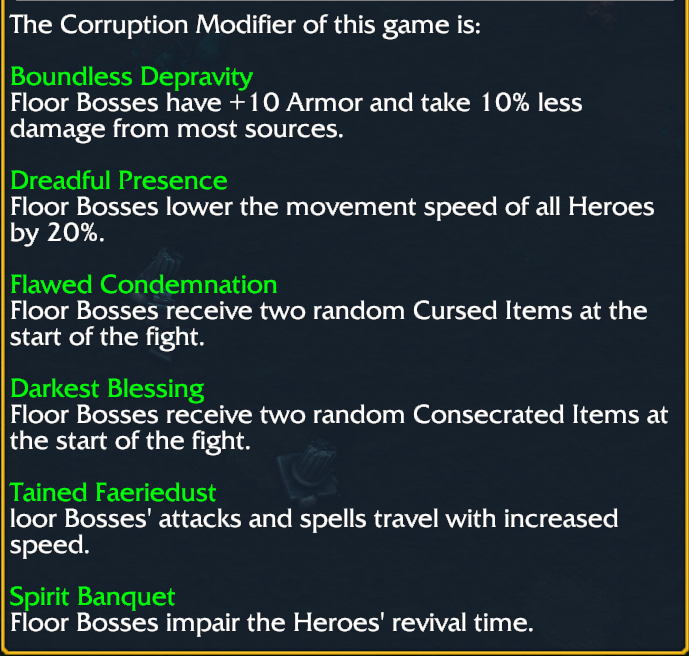
An optional game mechanic is the Corruption modifier. The standard game rule is random, which randomly selects one of the modifiers at the start of the game to impact the current playthrough. This gameplay addition strictly affects fights against the few enemies at the end of each section and subsequently the final level. These enemies are difficult even without modifiers, which affects the design choices. It is vital that most of these have mild effects to allow, for example, Darkest Blessing to be a large threat in the 1/11 games where it appears. That being said, the impacted enemies synergise with the same modifiers differently. A highly telegraphed enemy with slow attacks uses Dreadful Presence to great effect, whilst at the same time not utilising Diabolical Haste to its full potential.
Corruption modifiers are especially well-received, as they both offer gameplay variety and increased difficulty.
Replayability – Customisation
Playing the same hero with the same skillset playthrough after playthrough gets old. Roguelites pride themselves on offering a plethora of playstyles, and REV is no different.
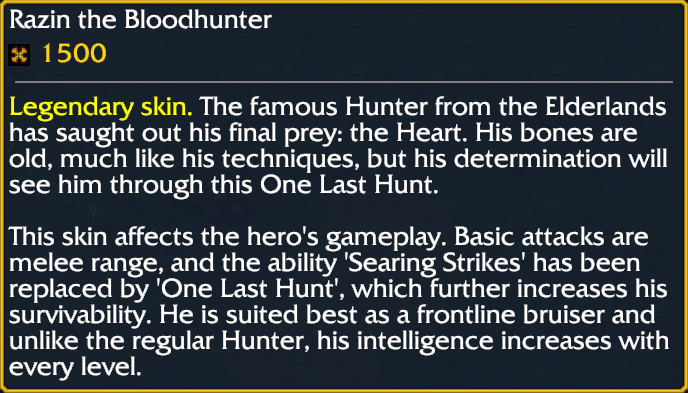
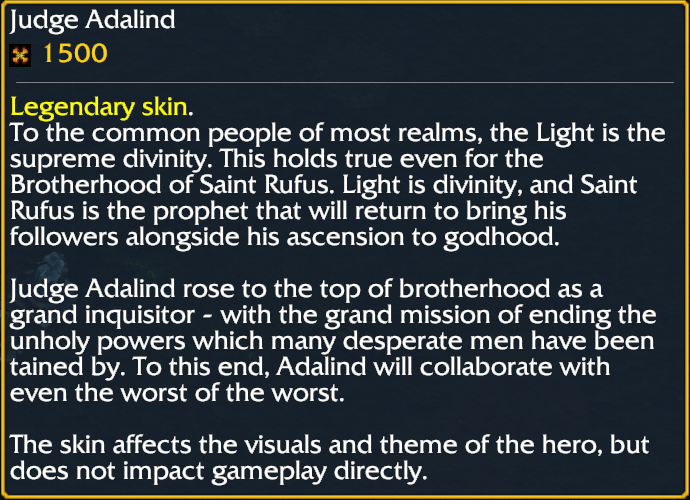
Skins is a reward for meta-progression, and they are generally cosmetic which means that they do not alter the hero’s gameplay. There are, however, exceptions to this since the creative design behind skins is to explore themes or background that might suit a hero. Thus, a hero that champions all that is holy might have a skin with an opposing narrative, and it may either retain the same gameplay with different VFX and SFX, or it may require an alternative playstyle and in those cases about 30% of the hero’s gameplay is replaced to reflect the desired playstyle. There are currently 113 different hero skins between the 17 different heroes, each with their own VO quips, and 37 of these have unique dialogue reactions the main cinematic, with the rest sharing dialogue with other skins that fit the same theme and identity.
Talents are upgrades that affect the hero, its base abilities or adds entirely new abilities. They vary in effect and can do all from hyping up one’s bread-and-butter to unlocking powerful ultimate abilities. Each hero has its own unique talents that none other share, and they are designed to specialise the hero into different playstyles, depending on the player’s preferences. A hero will generally unlock 1-3 talents depending on how long the playthrough is, making it impossible to evolve in every direction. Skins that alter the hero’s playstyle may have unique talents that the base hero cannot access, while at the same time losing access to certain talents. There are currently 176 unique talents in the game.
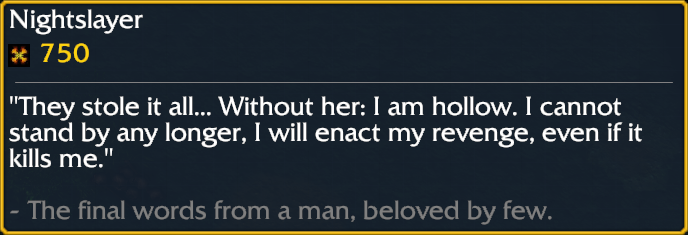
Hero: The Warlock
Description
The Warlock is a spellcaster who has made a pact with a demonic entity. The hero specialises in large-scale destruction through frequent grandiose abilities and compliments it through immaculate utility.
Narrative design
In a lot of cases, the gameplay design drives the narrative design, however, I came up with the narrative of a warlock before having formed the current gameplay iteration. A warlock is usually referred to a practitioner of sorcery and in some cases, a counterpart to a witch. This selfish theme was something that I wished to tap into: for the Warlock to be an unapologetic, heartless spellcaster. The Warlock’s presence should be recognised through unholy marks, cursed symbols and large flames. When I truly locked the Warlock’s theme into place, I built it around the Demonic Incarnation ability, which temporarily transforms them into a true last-boss. The Warlock has five alternative skins which explore different styles of demon-worshipping or the inheritence of the demons’ powers.
Gameplay design
The old iteration of the Warlock wasn’t good enough: it did not manage to capture the power fantasy of a warlock nor did the abilities truly synergise with each other. To remedy this, I returned to the drawing board; scrapping nearly the entire kit. The centre-stage of the new Warlock was Demonic Incarnation, which had previously been an an optional talent. Despite the talent being optional, it was commonly picked it as the first talent. It did not quite hit the mark last time and now it would be available for every Warlock. For the redesign to work it was vital that Demonic Incarnation provides bonuses that affect the hero’s playstyle. To achieve it, I opted for a workflow that fully fleshed out all aspects of the hero before production, even the talents which are mainly designed after the bae abilities. This halted the visible progress greatly, but allowed for the design to cohesively interact with all aspects of the hero’s gameplay.
Before I elaborate on the abilities in order, I must explain the Soul-Blaze. It is a passive attached to The Pyre ability. It activates through dealt-damage instances, meaning that the values of the other abilities are balanced with Soul-Blaze in mind. Upon activation, it restores mana and health depending on the amount of enemies hit. The Warlock has no real means of protection, and repeatedly casting spells is mana-intensive, thus the Warlock is incentivised to fight. The abilities are balanced around this extra bonus.
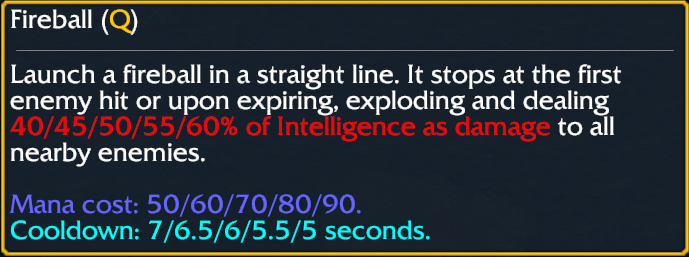
Fireball is a straight-moving projectile that explodes upon impact with an enemy or upon reaching max range, dealing damage in an area. It is the so-called Bread and Butter, which means that the Warlock cast this ability whenever it is ready. Its cooldown is low, but so is its damage. The Fireball’s explosion has merit also through the application of Soul-Blaze, which can lead to a larger restoration of mana than the consumption. As the ability received a theme through fire and flames, I connected to searing destruction rather than a burn-effect.
The ability’s format is hardly unique; there are both abilities that deal damage in areas, and projectiles that travel and continously apply damage. The specific design of a traveling projectile that bursts into a large area had not yet been done, making it the best way to distinguish the Fireball. The ability is deceptively simple on a technical level, but multiple difficulties related to the talents arose. The Bellowing Fire talent adds a subsequent explosion after a 0.75 second delay, which meant that the function handling the detonation had to be timer-based, among other things. Any edge case checks that handle detonations through expiration, for example, through a timer, also had to connect with the Bellowing Fire’s timer. The difficulty increased complexity more than anything else.
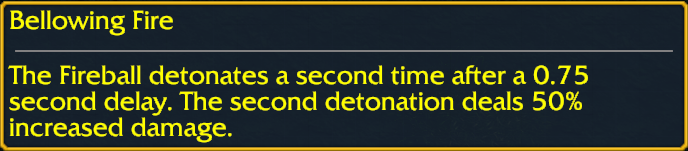

Another was the Flame Demon talent, which activates during Demonic Incarnation. Instead of one Fireball, three are fired instead. Keeping track of three different instances wasn’t the issue, rather it was the WC3 engine itself that objected. It did not want to both move the dummy projectiles, and keep track of when they should detonate at the same time. Through additional OOE, I split the functions, nearly multiplying them, to separate the Fireballs’ detonation condition from their movement.
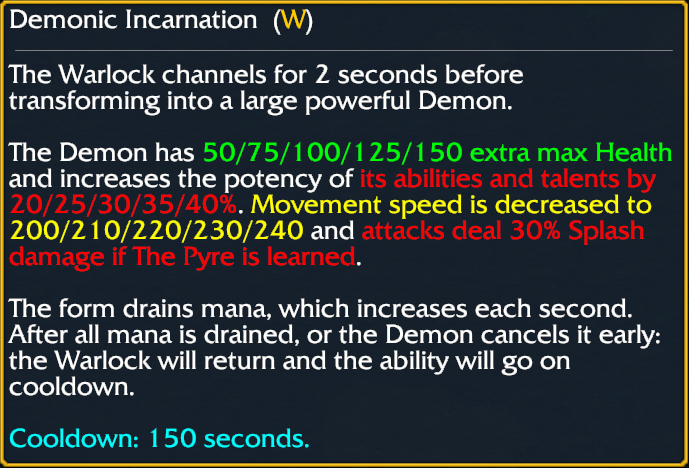
Demonic Incarnation is an atypical base ability, its design and theme is similar to ultimate ability. The Warlock transforms into a Demon to gain additional powers. Its mana is drained over the duration which becomes unsustainable over time. Due to the Demon’s extra powers, the Soul-Blaze triggers more easily and the restoration increases. Through this restoration the Warlock greatly extends its duration in Demon-form. Being a triumph-card, Demonic Incarnation is best used sparsely. Encounters have different difficulties, which can be further impacted by bad luck, and at those times it is easy to wish for Demonic Incarnation. This ability in itself does not have many specific talents, but it scales very well with the three Pact-talents, which are a set of talents that scale with Soul-Blaze, which the Demonic Incarnation uses quite well.
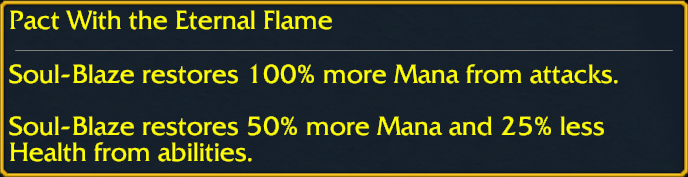

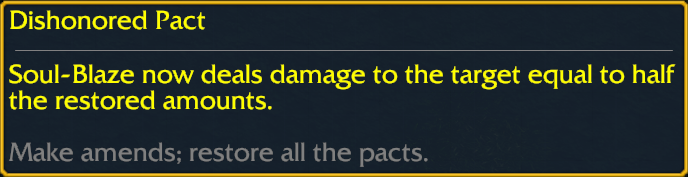
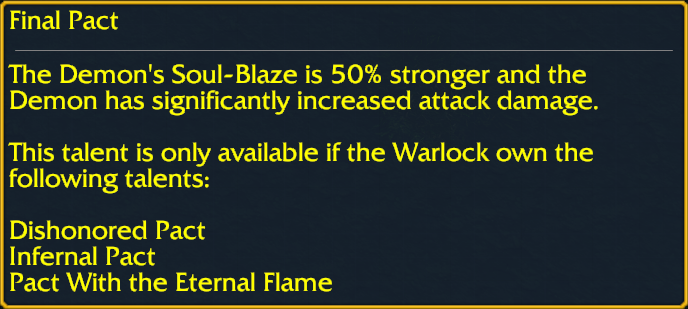
The ability has been notoriously difficult to work with, ever since its first iteration several years ago as a GUI ability. The reason is because it does not technically transform the hero in any manner: it is merely a trigger consisting of a set of functions that mimic a transformation. The base game contains transformation support, but due to REV’s system design it was not applicable. It was June 2026 when I managed to fully solve all the identified issues, and many of these issues were ridiculous. Several issues revolved around setting variables correctly between the transformation, which the game engine would not identify correctly nor properly update.
The final issues were about selection scale and health bars, which are intertwined, but in this situation they would update independently. When the native functions failed I had to scour the old forums deeply for any clues on the issues. Eventually, I found designers that dicsussed similar issues to mine, albeit for other reasons, which led me to my solution: I had to disable and then re-enable the Warlock’s rendering in between each transformation. This can be done in an instance and it does not visually register to players. This was not flawless, as it de-selected the hero for all players. So the final step was creating edge cases that handle the impacted players’ selections, which has to be done cautiously to avoid multiplayer desyncs. After achieving it, the transformation itself was perfect, albeit there are native WC3 abilities that force certain visual changes, which could have a temporary unintended impact during certain timings in the transformation. Identifying these types of edge cases allow for quite quick fixes.
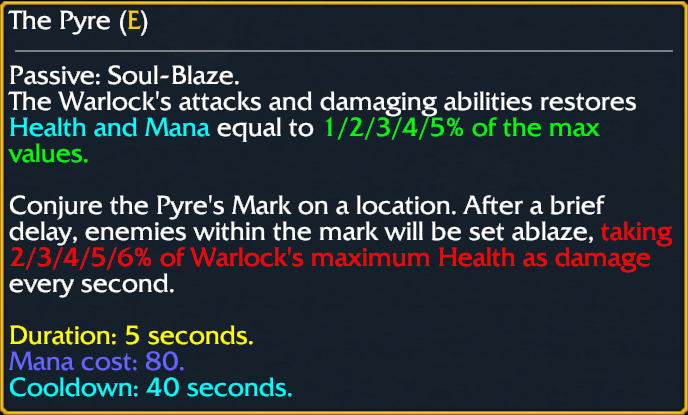
The Pyre is the final base ability. It can be used to cast a mark on a target location, and which detonates after a delay, setting every hit enemy ablaze and applying a DoT (damage-over-time). I previously described my preferences regarding fire, which is that DoT isn’t representative enough, and I stand by that. The Pyre’s functionality exists to synergise with- and apply Soul-Blaze. Each tick of the DoT applies Soul-Blaze. A possibility was to create a recursive damaging area, which technically would not count as DoT, but the gameplay is often quite fast and standing still is not always feasible, making it harder to get value out of the ability, especially considering the delayed activation. The Pyre’s active part only has one dedicated talent ability, although several others impact either its active or passive values.
As an ability it is weak. The Warlock loves to have- and use it, but its general power levels are low because it is both a passive ability and an active ability. This type of design is rare in REV, and therefore for it to exist, neither portion be too strong. This is noticeable through its low damage and high cooldown, and to offset the impression of it being weak, I intentionally used high impact VFX and SFX to make it seem impactful. There was another visual element planned to heighten the ritual-esque feeling, but the assets used were not compatible with the native functions. The technical implementation was quite smooth, and the only finnicky part was timing every effect correctly, meaning to visually blend end- and start points.
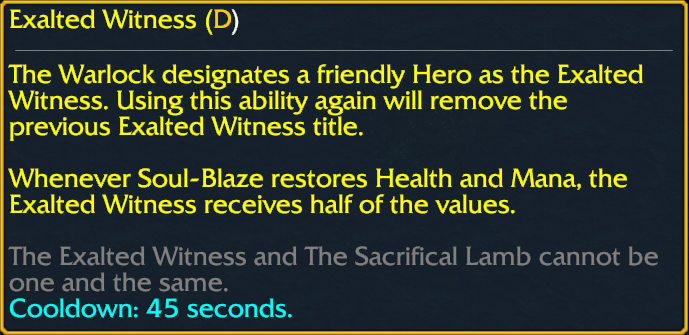
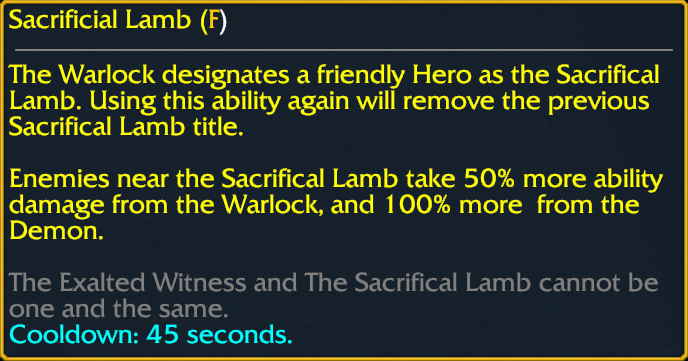
Exalted Witness (Talent) and Sacrifical Lamb (Talent) are two similar abilities that bonds allied hero to the Warlock. These abilities are free to use aside from their cooldown and are meant to be used frequently. They have no effect on their own, but enable the Warlock’s other abilities to interact with these heroes. Exalted Witness’ mark honors an ally, which shares the effect of Soul-Blaze with it. Through it, the Warlock can help its allies, but only one can bear this mark. It is also conditional, meaning if the Warlock doesn’t apply Soul-Blaze, it is effectively useless. Sacrificial Lamb is not harmful, despite its name, and should be used on a frontline ally. If the Sacrificial Lamb is nearby the Warlock’s damaging ability impacts, then the dealt damage is greatly amplified. Because I like intertwined interactions, I also added a unique interaction to Warlock’s Purgatory Pyre talent. If the Sacrificial Lamb stands within The Pyre’s activation, it is also hit, but the damage is converted into healing. This requires the two talents to work.
Exalted Witness came from my consistent desire for heroes to have an alternative that allow them to help their allies, and healing through dealing damage is pretty metal after all. The narrative drove the functionality of the bond, that the Warlock shows a form of reverence or exception towards an ally, whilst disregarding the others. Sacrificial Lamb also creates a bond, albeit a cruel one. The Warlock requests an ally to risk their life and to stand close to the enemies, so that the Warlock can wreck havoc.
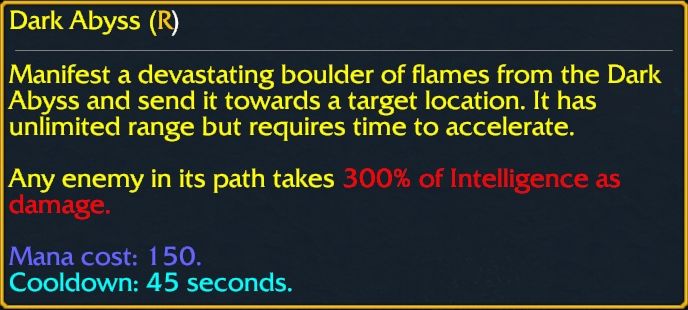
Dark Abyss (Talent)
The final talent I implemented was the Dark Abyss, an enormous flaming orb that hovers in the air after its activation. Its initial speed is puny, but it accelerates over a curve and eventually travels faster than anything else in the game. Any enemy that comes too near takes significant damage, scaling with Demonic Incarnation’s potency increase and potentially Sacrificial Lamb, and triggers Soul-Blaze. I enjoyed the idea of the Warlock conjuring an over-the-top ball of fire on a narrative level, and additional active abilities are always useful. It is considered an ultimate ability, hence its abnormal mana cost; while at the same time it should be used whenever its available.
Dark Abyss is heavily coordinated and hard to hit. Ideally it should strike an entire group lined up, but that’s easier said than done. Other players are factored into why it is outrageously strong on paper, as it is actually hard to reliably use Dark Abyss to its fullest. Therefore it is allowed to be strong on a relatively-low cooldown. Another issue lie on the artistic level, and it has been quite time-consuming. Dark Abyss is a hovering projectile and is therefore not on the ground. Where are most enemies? On the ground. As a fellow player watching this ability it may be difficult to identify its exact trajectory or which enemies will be hit. The solution would be two visual effects: a circle marker on the ground below, and a trajectory line marker. The circle marker marks the radius, and the line helps allies set-up recognise the trajectory. The problem is getting these visual rights. Neither attempts at a circle nor trajectory indicator have been successful and have simply felt off or distracting. It hits the mark on both design and narrative, but lacks the desired clarity with the assets and systems at hand.
The Warlock has a total of 11 optional talents, and the goal was to make them as interesting as I could within the scope.
Content: Interactive Dynamic Narrative
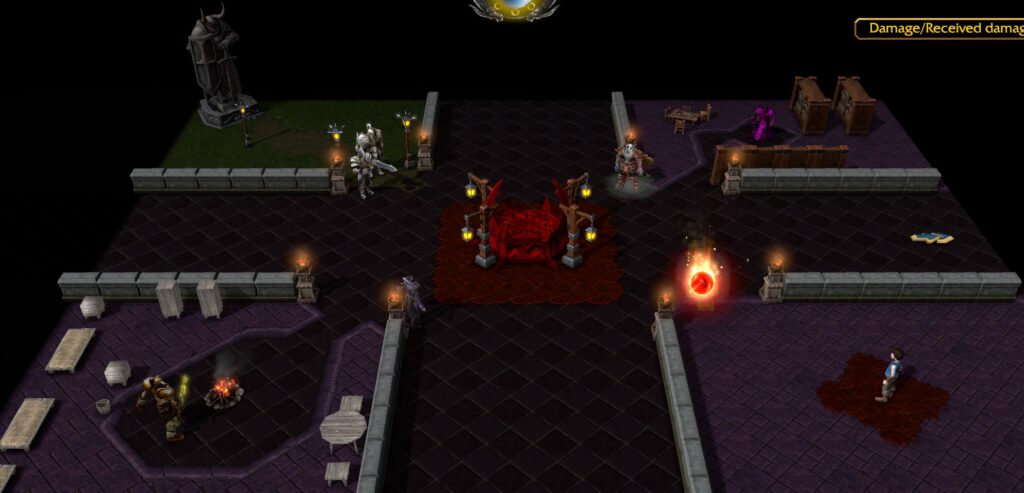
The players are not alone and can encounter up to 10 different characters, known as curios and act as a mix between NPCs and event-generators. These curios take part in the narrative and interact with the players. They offer a total of 67 different scripted interactions that impact either the hero, the hero’s group, the playthrough or other curios. Three of these interactions are large questlines with different resolutions. Whenever the group enters the level, they randomly meet one of these curios.
Curios’ interactions are dynamic in nature, and interacting with them affect the other offered interactions. Each interaction generally belongs to relationship path, for example, hostile actions towards a curio removes the friendly interactions. That’s not all though, they also have to make sense narratively. Interactions can be require the curio’s time and efforts, which makes them limited in nature and may disable other heavy requests. Having formed a group, the players debate with each other and make deliberate choices, primarily for the gameplay benefits, but also in relation to the curio at hand. Some decisions are more extreme than others, which can result in dangerous encounters or the loss of curios.
Depending on whom the players interacts with, the interactions’ consequences may either be transparent or obscured until the reveal. Friendly curios have more explanatory interactions, whilst a scheming one may pull out some tricks or react in an arbitrary manner. REV values player agency, and in this context that means that players should be in control of their heroes, and any negative consequence should occur through player choice. Curios, as a form of event-system, has proven to be successful as it engages players with the narrative, encourages strategic thinking as well as enabling heroes to achieve different power-fantasies.
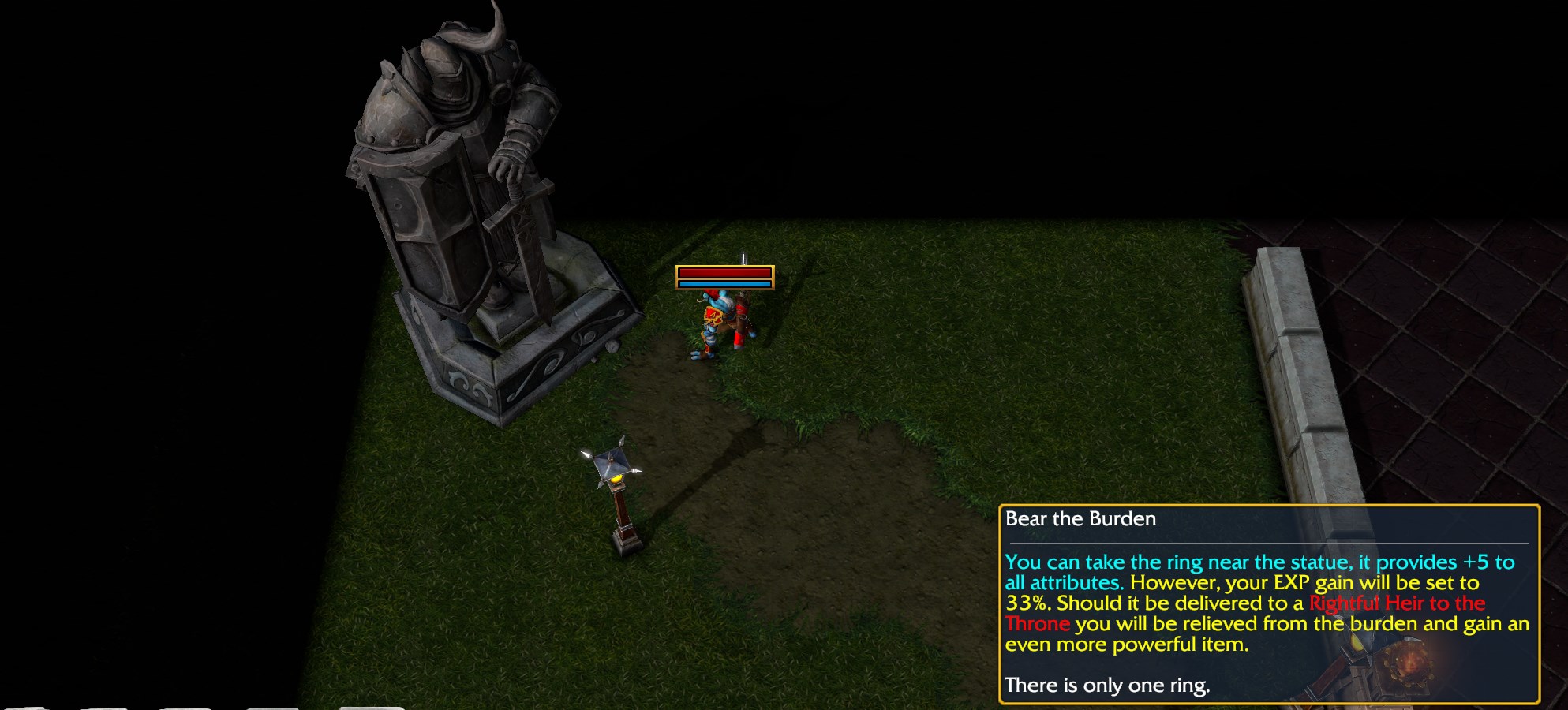
Content: Events
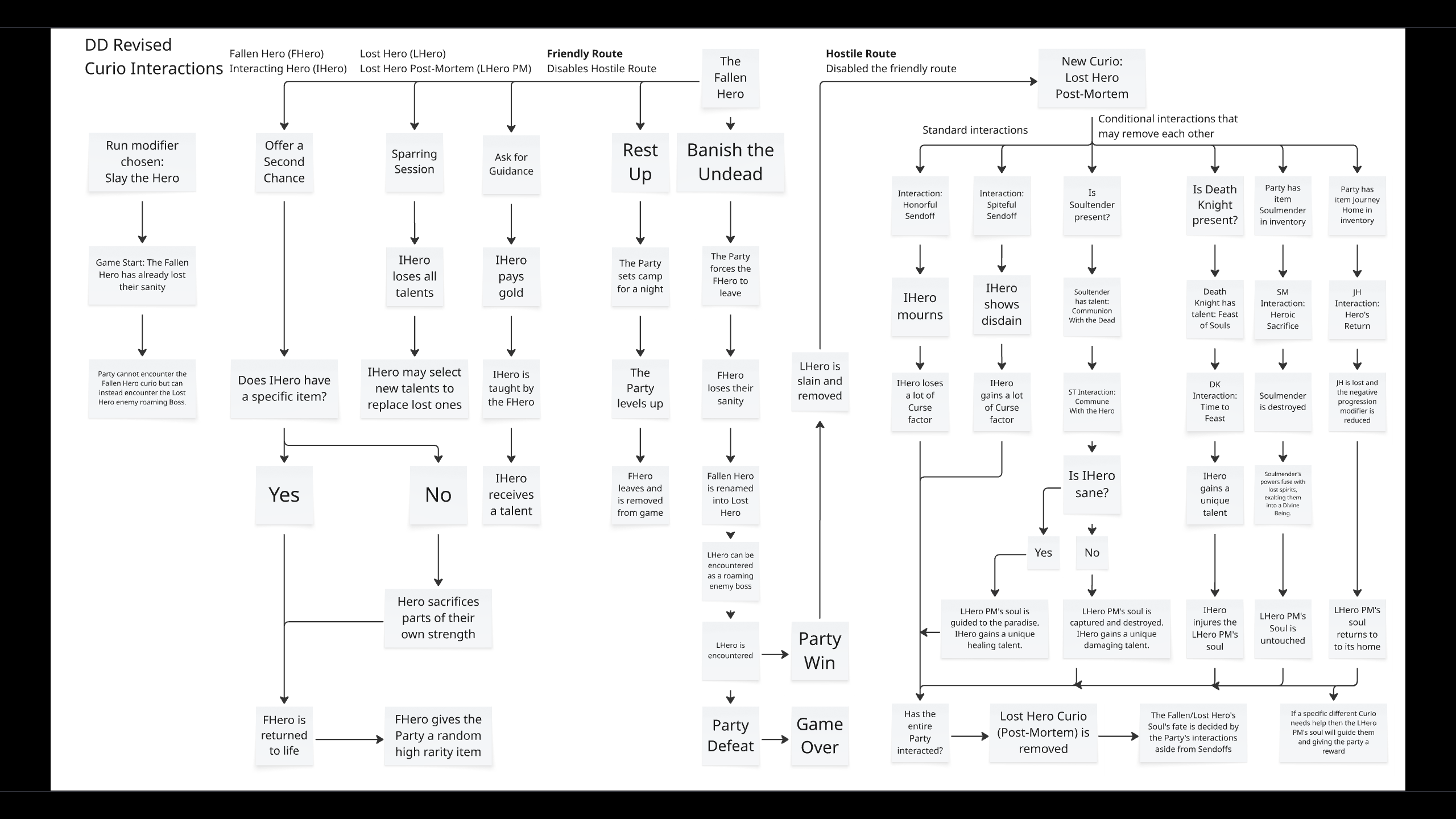
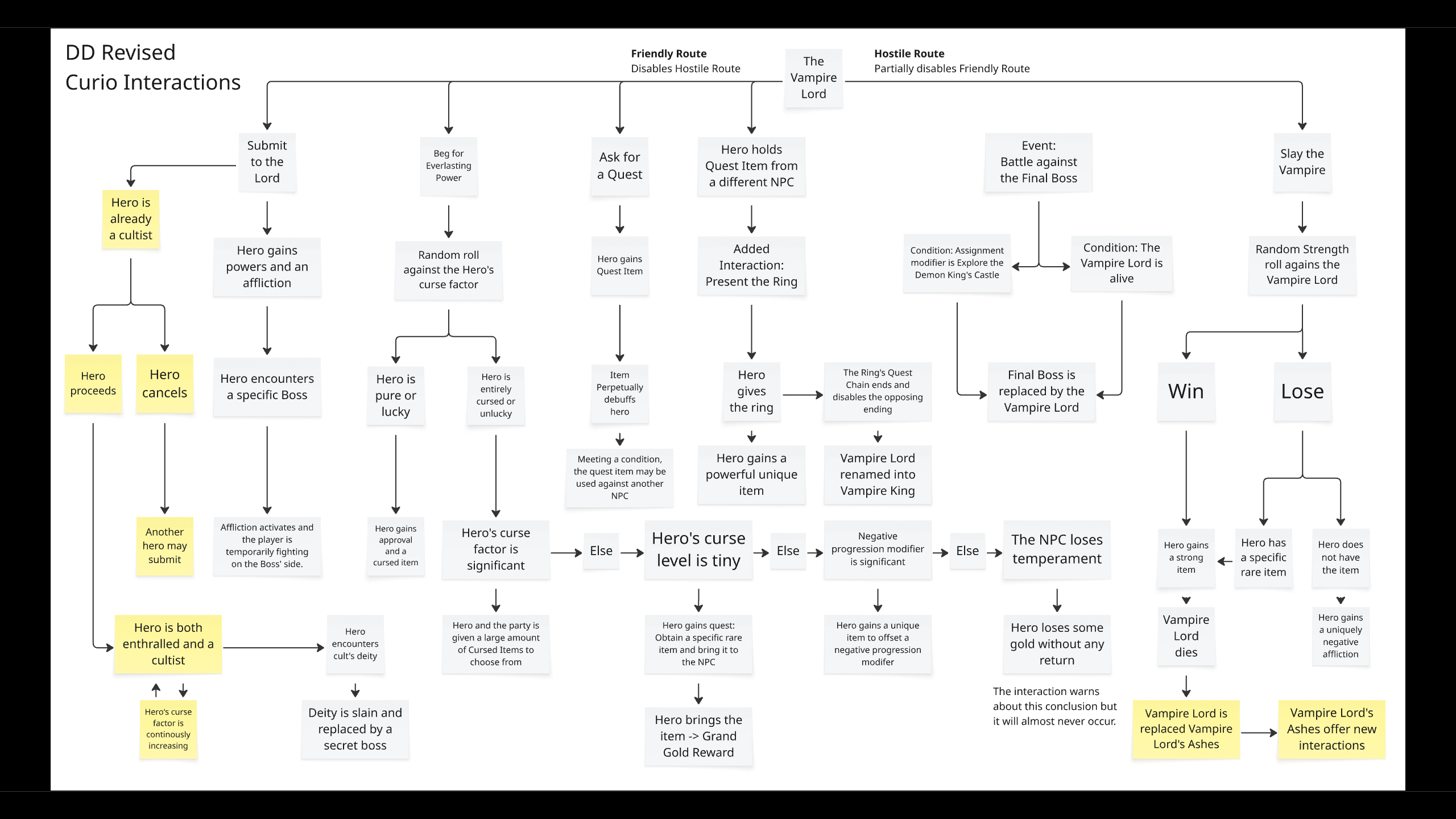
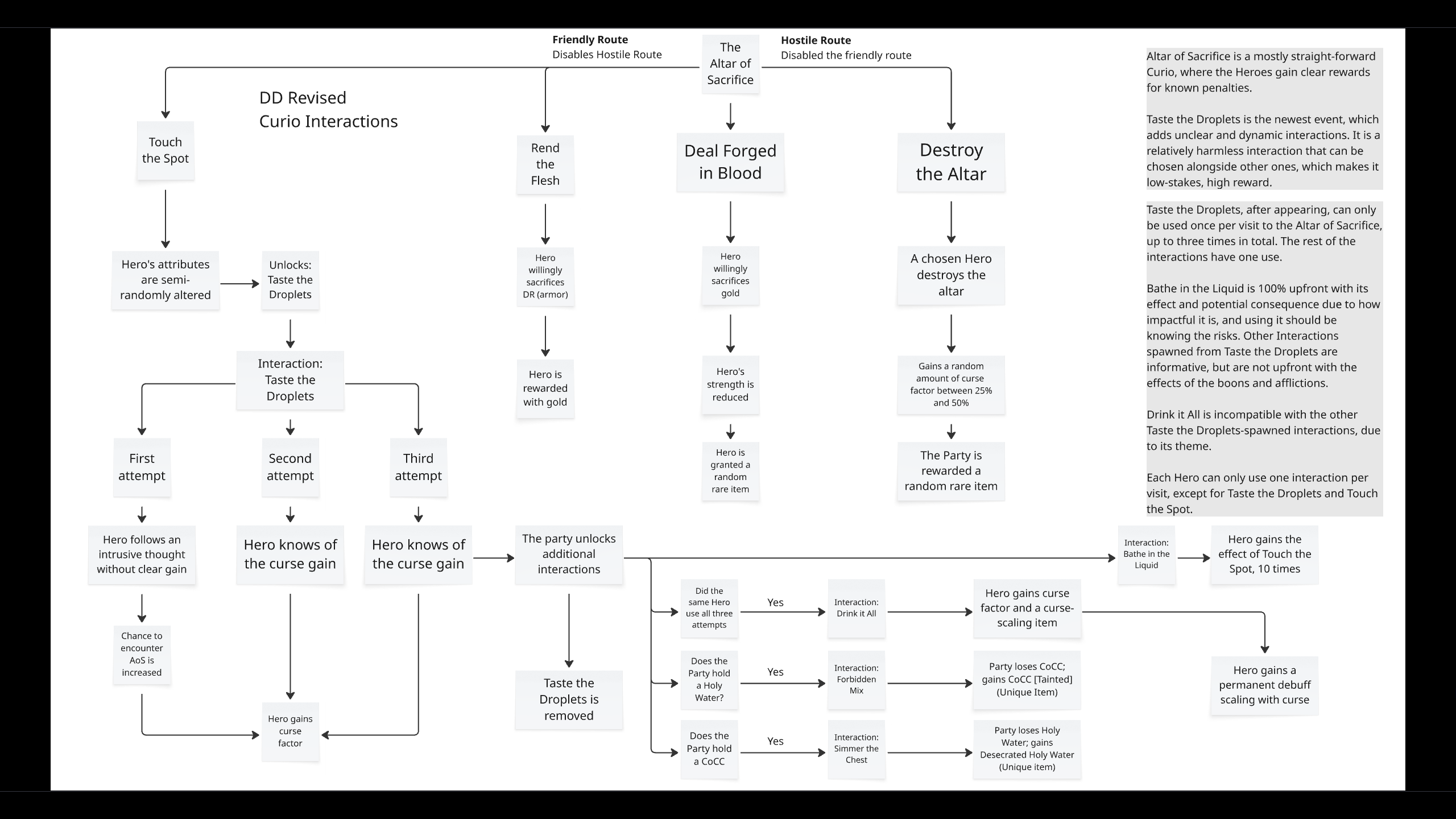
The flowcharts here display the three of the curios’ available interactions, their outcomes and the potential paths. Parts marked yellow are not yet implemented, although their functionality has been designed. Inquire about these if you are interested!
These events and interactions have different design philosophies to them, depending on the curio’s personality or purpose. The Altar of Sacrifice is an inanimate object: its form is a desecrated stone altar permeating terrible emotions. It has no will of its own and its purpose is to take one thing and give another thing back, similarly to an exchange. Because of that, the players must be informed of what their sacrifices are and how it works. It is their hero and their character at risk, so whenever something threatens to change it, there must be obvious and transparent warning signs. The player accepts an exchange and reaps the reward (and consequences) from it. The reason why Taste the Droplet is allowed to be dynamic and obscured is because of how subtle its consequences are. A good example would be an experienced ranger travelling through woods and accidentally scrapes itself on a thorny brush; the impact on the ranger is nearly nill. Of course, the player learns of TtD’s consequences after the first time which means that the effects and consequences become less subtle, more obvious and more impactful.
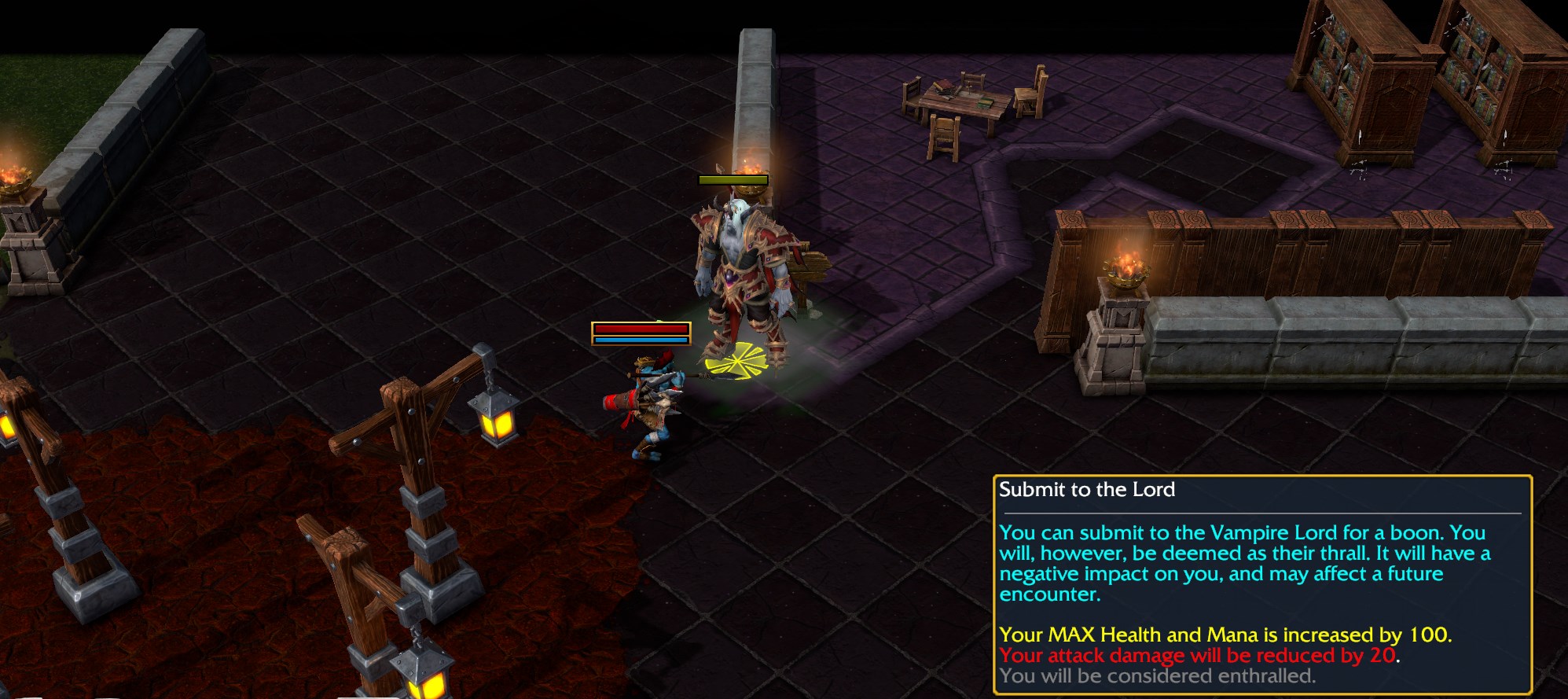
Different to inanimate objects is the Vampire Lord. This curio is notably strong in the narrative, arrogant and has multiple schemes in effect. Nearly all of the VL’s interactions revolve around doing his bidding, to obey his will and perhaps gain some boons for doing so. He has no reason to help the hero’s group, unless he would gain something out of it, which means that the players’ information regarding interactions is almost entirely told from their own perspective. The standard rewards are transparent, but the consequences are somewhat obscured. He is telling no lie, but the players are informed that some decisions may have a negative impact later on. That being said, the negative consequences are mild or have a cure to them, aside from failing to defeat the Vampire Lord, which is an interaction that requires the players to be properly informed beforehand.
The counterpart of the Vampire Lord would be the Cold Woman. She is a diligent and goodhearted curio that effectively works against the Vampire Lord. Once again, the curio’s narrative theme affects the design. She speaks the truth and attempts to collaborate with the party; offers multiple beneficial interactions. Aside from the interactions related to two different over-arching questlines, she does not have any hidden or dynamically changing events. The CW’s interactions affect the current variables of the heroes, the toughest enemies and the game rules. The players have exact information on what each interaction entails and may deem her as that she reliable or trustworthy, unlike a certain Vampire… That being said, two of her interactions reroll the game’s current variables, meaning the new results will be randomised and impossible to predict. The players know this and weight-up the potential risks of changing their fate.
All ten curios in the level have their own themes, backstories, narrative relevance and design philosophies. Their relevance and importance depend on the game state, and what I mean by that is that players do not constantly think “this one specific curio is OP and will always be desirable”, they rather hope for specific curios that would be perfect for the situation at hand.
On a technical level, each curio has their own unique models, icons, SFX and VFX to engage players in more ways than imagination and reading.
Role, Work and Disclaimer
I have worked in nearly all design fields throughout the development of REV, including but not limited to: Interative, Gameplay Loop, UX, Level, Creative, Narrative, Content, QA, Sound, Programming and Scripting. The mod is finished, but occasionally receives post-release updates.
I do not hold the rights to any the game Warcraft III, its assets, nor the graphical or sound assets within this game mod’s files aside from the music track referred to as Battle2.mp3; they belong to their respective owners. The mod is free to play, open source, community hosted and was developed as a hobby project. Darkest Dungeon Revised has no affiliation with any other IPs nor does it attempt to infringe on them.
Statistics
Hosting is done through instantiating a lobby online on Battle.Net and starting the game. Recorded data was saved from wc3stats.com.
16/01/24 – 10/02/24: Reforged 1.2+ was hosted 330 times. Revised Beta was hosted 209 times (data fetched 12/02/24).
09/02/24 – 21/02/24: Revised was hosted 751 times, ranking it as the 63th most popular mod (data fetched 22/02/24).
15/06/24 – 22/06/24: Revised was hosted 268 times, ranking it at as the 43th most popular mod for the week (data fetched 23/06/24).
Revised 1.0 (r. 28/07/24) was hosted 635 times between 19/08/24 and 25/08/24, ranking it as the 41th most popular mod (data fetched 27/08/24).
Additional media
Work
Prototyping
I mainly develop digital game prototypes in Unity. The workflow begins with planning the design and writing up documents. Afterwards is either finding or creating assets from scratch.
I draw 2D placeholders using Krita, GIMP or PS. Finally stage is setting up the project, necessary scenes, prefabs and scripts. This usually goes quickly if the plan is clear.
Programming and Engine
The languages commonly program in are C# and vJASS, with a basic understanding of C++. I am quick to adapt to and learn different syntaxes and technical structure.
While Unity is my main engine, getting used to others such as Unreal, Godot or any in-house is not a problem.
Monitoring and QA
Throughout previous projects there has been a necessity to playtest, optimise and improve. I have worked on both my own code and others’ scripts to improve it. Tools such as CPU-monitoring have been used to view the stacks and script overhead.
Outside of the Industry
Introduction to Design
As I child I spent my time play around in World Editors like that of Command and Conquer and Warcraft III. It led to my fascination with game design, and at the age of fourteen I released a semi-large project and delivered hero designs for a MOBA.
Kulturnatt Stockholm and Collaborations
In collaboration with the largest game shop in Stockholm, TTRPG association Alaria and I have hosted and participated in several events to share the magic of TTRPGs with beginners!
I since GM’d both story scenarios and sandbox campaigns for 9 years.
University-graded
I wrote my Bachelor’s Thesis on something I enjoy: game design. My and I designed a TTRPG-prototype, a narrative and the content. The results were fascinating and have become a great tool of mine. The thesis is complete and approved. Let’s discuss it!
Other Projects
Status: In Development · PHB at 152 pages, ~42,000 words. Currently being playtested in a story campaign for the 4th iteration.
A slow-burn system built around player agency, in both roleplay and combat. Its narrative design is a mix between Dark- and High Fantasy, where there are fantastical and magical aspects that work really well with player expectations and player fantasy, but also a grim reality that either shows its face at a moment’s notice or manifests over a longer period of time. A PC in this system should feel high highs and low lows, which is not a clear description, but it means that through customization and chosen paths, the player can achieve a fulfilling and rewarding fantasy and role. At the same time, the players are aware that losing their PC is always a risk, and through horror and failure, most PCs also gain negative afflictions that makes their vulnerabilities clear. Most negative effects and situations are preventable, the system is designed to give the players several tools to keep their PCs in good shape, but agency is very valuable and it is up to the players how and when these tools are used.
PCs are extremely customisable, with 150+ perks across four categories on top of the core character choices, which in turn are intended to reach 200 different core choices. Should one randomised the intended choices for all categories, it is likely a combination that has never existed before.
The system supports both linear story campaigns and sandbox-centered ones. Long or medium-long campaigns are the most appropriate for the system, since it’s designed to build up the PCs over time. Short campaigns are possible although the recommendation in that case is to start at a high-level and allow players to have their power fantasies. The system’s narrative is present through several gameplay components, but it also supports custom narratives. The existing narrative have specific pillars that can be replaced by custom pillars, thus attaching the content to the new narrative.
The system has been playtested over ca. five years with large breaks in-between. The current iteration is called the 3rd, due to how drastically it has changed before reaching the current one. The goal has been to create a system with fluid gameplay and streamlined rules that allow the GM to focus on the storytelling and experience. Project R is a professional project despite being entirely developed by myself and I aim to one day have it published.
Status: Demo/Prototype Complete and published.
Student project developed in Unity, active development time was ca. 8 weeks. It is a 2.5D Platformer set in a fantastical world inspired by Swedish autumn.
My role primary role for this project was Technical Designer. In this role I developed the general architecture that drove the game forward and how different systems connected to each other. Later on, my work branched off into both QA and Level Design. The QA work entailed playtesting and CPU monitoring, which led to troubleshooting and the patchig of errors and issues with scripts and object orientation. This work was a necessity which led to both optimised gameplay and runtime load.
My level was the the first half of the second level, which came with both narrative and gameplay to consider. During the design process, I had to study and interpret object shapes, sizes, spaces in with regards to the player and other objects. These objects required colliders and had to be placed with the puzzle section in mind. Since the game is 2.5D, it was modelled in a 3D space on a linear path, thus making it slightly more complex as both foreground and background had to be taken into consideration, and these were mostly 3D objects as well. The camera, for the player to finish the puzzle, needed follow the player as intended, display helpful information at vantage points, and to not reveal anything beyond the set-pieces. Fortunately, having programmed the camera previously, I had an easier time adjusting its parameters. Once the level’s layout was finished, the scene was handed off to another team.
My work in overall throughout the project was in no means perfect. I made mistakes and found myself lacking in certain areas, but these mistakes were mine to fix and learn from. Since we worked in a smaller team, it was not feasible for me to stick with my specialisations nor comfortable design-areas. It gave me the opportunity to branch out and do my best in aspects of which I lacked experience, and while it was tough, it evolved into a challenge that came to appreciate. In the end, I humble recognise my learning points, but at the same time hold pride over our accomplishment. The largest blunder would be the documentation for the technical design, it was unfortunately an afterthought that ended up not being clear enough.
We tried to emulate a professional work-environment in our team and followed agile development practices. For this project, we also used pre- and post-production phases to assist the main production phase. It was a challenging yet rewarding experience to work on this project, as both a part of a larger team and a smaller one.
All in all, while most of my projects and prototypes are developed by myself alone, I enjoyed and had a great time working together within larger teams. It is something that I look forward to after Fomalhaut.